Better Touch Better Business
Contact Sales at TIANYINGTAI.
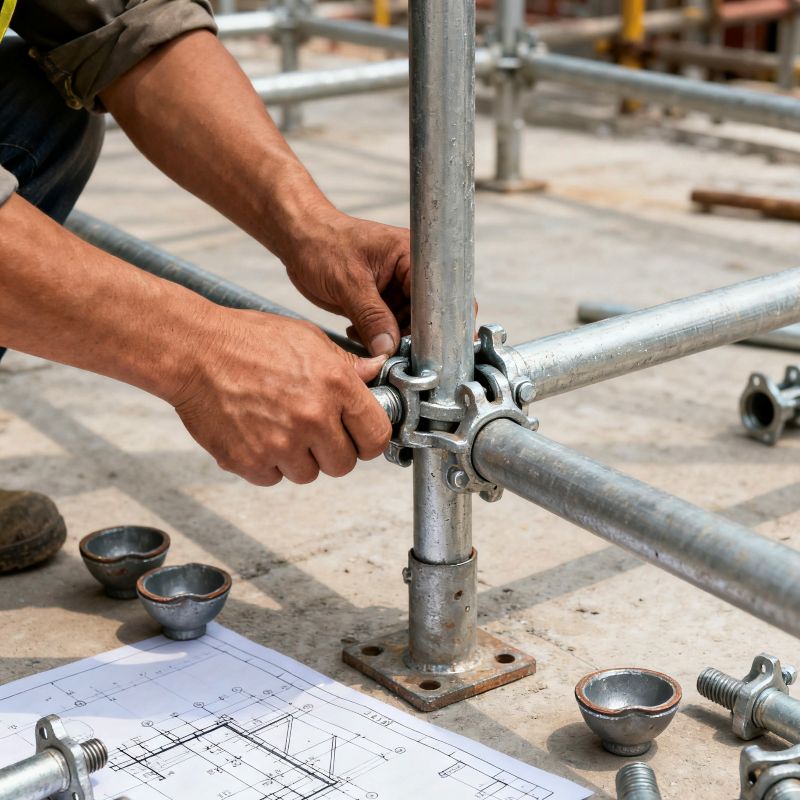
Cuplock scaffolding is a revolutionary socket-type steel pipe scaffolding system, with its core innovation being the unique toothed cup joint design. This scaffolding primarily consists of vertical poles (standard length 3130mm, weight 17.07kg), horizontal poles, and specialized cup lock connectors. Fixed cups are welded onto vertical poles at 0.6m intervals, while horizontal poles feature special connectors at both ends, enabling quick assembly through simple hammering.
The connection mechanism utilizes spiral friction and self-weight for self-locking functionality. Loads are transferred to vertical poles through lower cup joints, ensuring high safety reliability—even if upper cups aren't fully tightened, horizontal pole joints won't disengage. With all pole axes intersecting at a single point and nodes located within the frame plane, the system forms a stable geometrically invariant structure.
Versatile Configuration Capability
Can flexibly form single/double-row scaffolding, support frames, columns, material hoists, climbing scaffolds, cantilever scaffolds, and other construction equipment
Particularly suitable for curved scaffolding and heavy-load support frames
Extendable for temporary shelters, storage sheds, lighthouses, and other auxiliary facilities
Exceptional Construction Efficiency
Assembly speed 3-5 times faster than traditional scaffolding
Requires only a hammer for operation, eliminating bolt connections
Standardized components (maximum 3130mm length) facilitate transportation and on-site management
Excellent Compatibility
Main components use universal steel pipe specifications compatible with traditional coupler scaffolding
Can connect with ordinary steel pipes using couplers
Superior Load-Bearing Capacity
Excellent bending, shear, and torsion resistance at joints
15% higher load capacity than coupler-type steel pipe scaffolding under equivalent conditions
Maximum shear resistance of horizontal pole joints reaches 199KN
Comprehensive Safety Design
Includes safety net supports, intermediate horizontal poles, scaffold boards, toe boards, ladders, and other accessories
Special cantilever beams and wall ties ensure high-altitude work safety
Despite its advantages, the Cuplock system has certain limitations:
Structural dimensions constrained by fixed-length horizontal poles and 0.6m spaced cups on vertical poles
Potential loss of U-shaped connecting pins
Relatively high initial investment cost
Introduced from Europe in the 1980s, Ringlock scaffolding is considered an upgraded version of Cuplock. Invented by German company LAYHER, it's commonly calledLayher Scaffold or "chrysanthemum ring scaffolding" in China. Originally designed for concert lighting trusses and backdrop frames, it's now widely used in various construction projects.
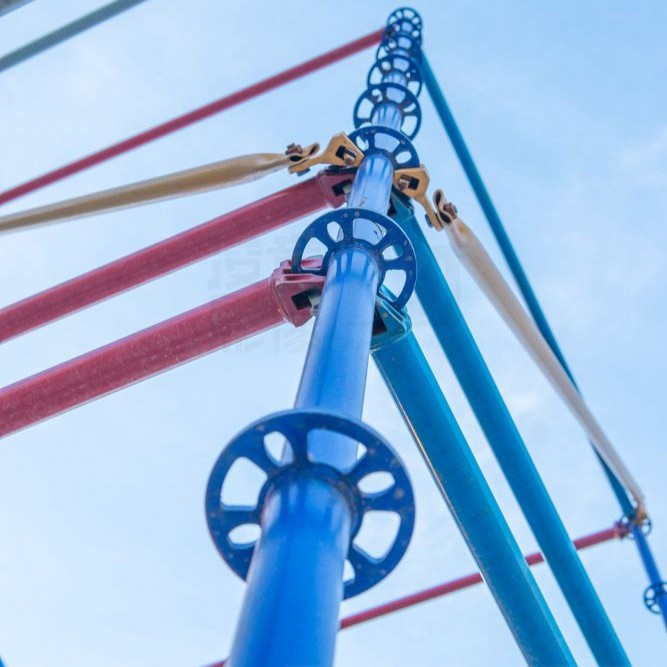
Ringlock scaffolding uses φ48×3.5mm Q345B steel pipes as main components, with key features including:
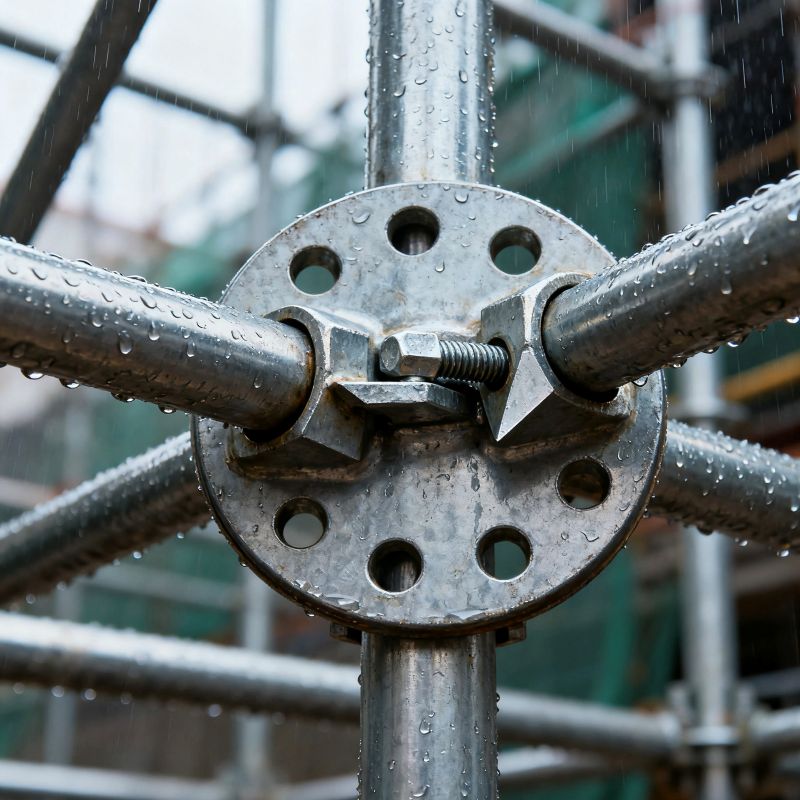
Vertical Pole Design: 133mm-diameter, 10mm-thick 8-hole rings welded at 0.60m intervals, with connecting sleeves at the bottom
Horizontal Pole Design: Plug-in connectors welded at both ends for direct insertion into vertical pole rings
Joint Strength: High-strength steel and precision welding ensure exceptional joint load capacity
Modular Design Concept
Standardized ring connections enable multi-directional simultaneous connections
Can form space truss structures suitable for complex geometries
Enhanced Construction Efficiency
Plug-in connections are faster than Cuplock
Reduced accessory count simplifies management
Improved Safety Performance
Multi-directional connections provide better structural stability
Higher joint rigidity and deformation resistance
Aesthetics and Economy
Advanced surface treatment for clean appearance
High material utilization rate lowers long-term costs
Broad Applicability
Especially suitable for large-span, high-formwork complex conditions
Performs exceptionally in bridges, railways, and other infrastructure projects
Prioritize Cuplock When:
Small/medium construction projects
Limited budget but needing efficiency improvements
Requiring compatibility with traditional coupler scaffolding
Curved scaffolding needs
Prioritize Ringlock When:
Large public buildings, bridges, and high-standard projects
Large-span, high-formwork complex conditions
Projects demanding extreme efficiency
Frequent scaffold shape changes required
General Applications:
High-rise building construction
Industrial plant construction
Temporary facility setup
Maintenance and repair projects
While Ringlock has the highest initial cost, it may offer better long-term value:
Cuplock System: 20-30% higher initial cost than traditional scaffolding, but labor savings and higher turnover typically recover the difference in 2-3 projects
Ringlock System: 15-25% higher initial cost than Cuplock, but longer service life (10+ years) and higher turnover rates deliver significant long-term economic benefits
Q1: What's the maximum erection height for Cuplock and Ringlock scaffolding?
A1: Both can theoretically exceed 100m, but practical allowable heights depend on loads, wall tie arrangements, and foundation conditions. General building scaffolding is typically limited to 50m, with special designs required beyond that.
Q2: Can these scaffolding systems be used together?
A2: Not recommended. While main pipe specifications are identical, incompatible connection systems create uneven joint stiffness and safety risks. If mixing is necessary, specialized structural calculations are required.
Q3: How to choose the right scaffolding system?
A3: Consider these factors:
Project scale and timeline: Large fast-track projects favor Ringlock
Budget constraints: Cuplock offers better cost-performance
Project complexity: Curved/irregular structures prefer Ringlock
Future usage plans: Long-term multi-project use makes Ringlock more economical
Q4: What international standards apply to these systems?
A4: Main reference standards include:
EN 12810/12811 (European scaffolding standards)
BS 1139 (British standard)
AS/NZS 1576 (Australia/New Zealand standard)
GB 51210-2016 (Chinese unified safety technical standard for construction scaffolding)
Q5: What precautions are needed under extreme weather conditions?
A5: Special considerations:
Suspend work when wind exceeds level 6
Check for foundation settlement after rain/snow
Account for thermal expansion in high temperatures
Be aware of increased steel brittleness in cold regions
Copyright © 2019 Tianjin Tianyingtai Steel Pipe Co., LTD. | All Rights Reserved